

If your Frigidaire dishwasher leaves dishes dull or spotted, or if you notice a musty smell every time you open the door, the culprit is almost certainly a clogged filter. This small component works hard to trap food particles, grease, and debris — but it needs regular cleaning to do its job. The good news? You can restore sparkling performance in about 15 minutes with no special tools. This guide walks you through every step, from locating the filter to reinstalling it correctly, so your dishwasher runs like new.
 The filter after a thorough cleaning — notice the absence of any debris or grease buildup.
Credit: www.youtube.com
Why a Clean Filter Matters
A dirty filter doesn’t just make your dishwasher work harder — it directly affects the cleanliness of your dishes and the lifespan of the machine. Here is what happens when the filter gets clogged:
- Poor water circulation – Water cannot reach every dish, leaving food residue on plates and glasses.
- Lingering odors – Trapped food decomposes, creating a sour smell that can fill your kitchen.
- Pump strain – The pump has to push water through a blocked pathway, which can lead to premature motor failure.
- Incomplete drainage – A severely blocked filter prevents water from draining, leaving a puddle at the bottom of the tub.
- Mold and bacteria growth – Moisture combined with food particles creates an ideal environment for microbes.
In practice, a filter cleaned once a month prevents these issues entirely. For households that run the dishwasher daily or wash heavily soiled pans, every two weeks is smarter. Regular appliance upkeep is a small investment that pays off in avoided repair bills.
 Even a light coating of grease can reduce water flow significantly.
Tools and Materials You’ll Need
Gather these items before you start — having everything at hand makes the job quick and frustration-free.
- Soft-bristled brush – An old toothbrush works perfectly for scrubbing mesh and crevices.
- Mild dish soap – Avoid harsh chemicals or bleach, which can degrade the filter material.
- Warm water – For rinsing and soaking.
- Microfiber cloth or towel – To dry the filter and catch drips.
- Rubber gloves (optional but recommended) – Protects your hands from sharp debris and greasy residue.
- Small basin or sink – For containing water during cleaning.
- White vinegar or baking soda – For tackling stubborn mineral deposits or mold.
- Screwdriver (rarely needed) – Some older Frigidaire models use screws to secure the filter housing; most modern models use a simple twist mechanism. Check your user manual if unsure.
If you prefer a gentler approach, a homemade degreaser solution works well on oily buildup without risking chemical damage.
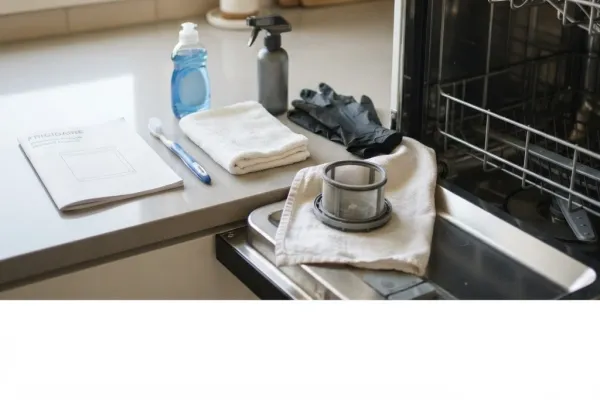 No specialized tools are required — a toothbrush and mild soap will do the job.
Safety Precautions
Water and electricity are a dangerous combination. Take these steps before opening the dishwasher interior.
- Unplug the dishwasher – Pull the power cord from the wall outlet. Never rely on the circuit breaker alone.
- Shut off the water supply – Locate the valve under the sink (often a small lever or knob) and turn it clockwise to close. This prevents accidental leaks if you dislodge a hose.
- Wear gloves – Food debris can include broken glass or sharp bone fragments. Gloves also keep your hands dry.
- Use a flashlight – The bottom of the dishwasher is dark. Good lighting helps you see debris and avoid forcing parts.
- Watch for sharp edges – The interior metal edges around the filter housing can be sharp. Work slowly.
A quick glance at your Frigidaire owner’s manual — available online through Frigidaire’s official support page — will confirm any model-specific warnings.
 Always unplug the dishwasher before reaching into the tub.
Locating the Filter
Frigidaire dishwashers place the filter at the bottom of the tub, under the lower spray arm. Here is how to find it:
- Open the door fully and pull out the bottom dish rack. Lift the front slightly to disengage the rollers from the tracks, then slide it out.
- Scan the floor of the tub. You will see a circular or oval assembly — usually near the center or toward the back corner.
- Look for a two-part system: a coarse outer filter (plastic mesh or screen) and a finer inner filter (stainless steel or fine mesh). Both are typically removable together.
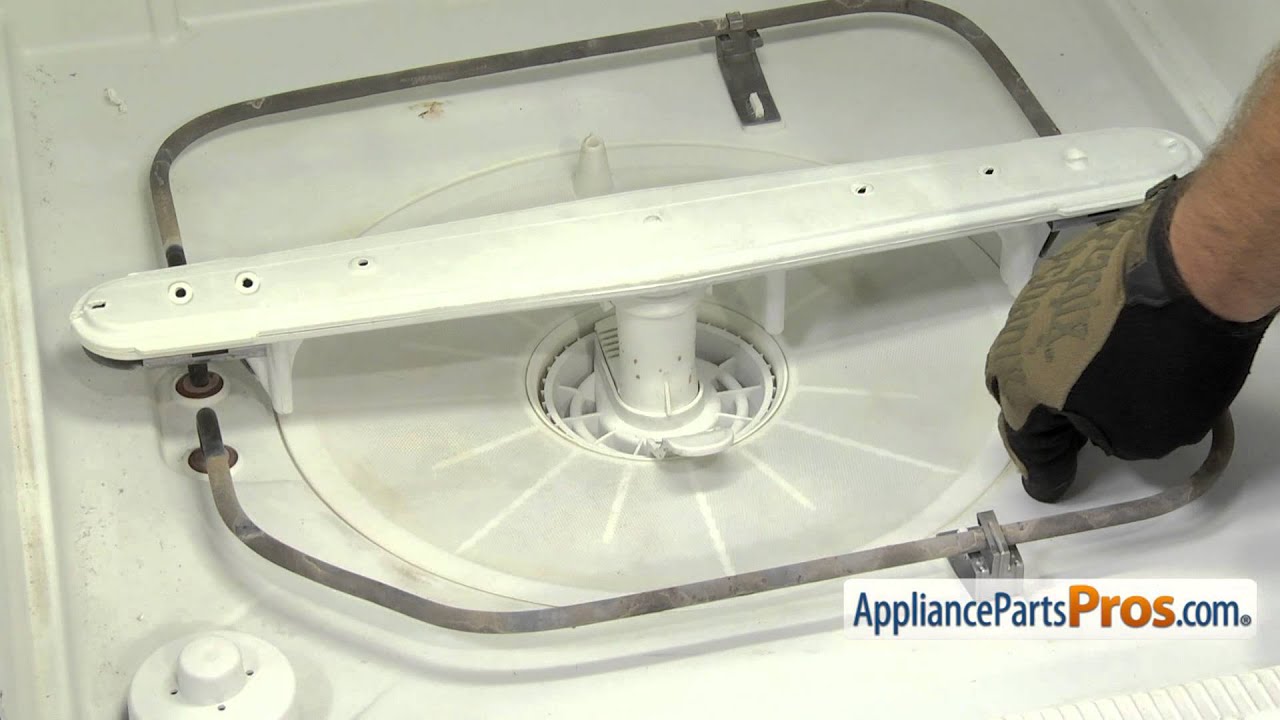
On most Frigidaire models, the filter sits in a recessed well. If you see a spray arm above it, you may need to lift the arm slightly to reach the filter. The diagram below shows the typical layout.
 The filter assembly is often positioned beneath the lower spray arm.
Credit: lakeappliancerepair.com
Still can’t find it? Your manual will have a labeled diagram. If you’ve lost the paper copy, search “Frigidaire [model number] filter location” online — the part number is usually on a sticker inside the door edge.
Removing the Filter
Once you’ve located the filter, removal is a straightforward twist-and-lift action.
- Identify the locking mechanism – Most filters have a small handle or notches around the rim. Look for an arrow or “lock” icon showing the direction to turn.
- Turn counterclockwise – Grip the filter firmly and rotate it to the left. You should feel a click or a release. If it resists, check that no spray arm or rack track is blocking it.
- Lift straight up – The filter will come out with a small amount of water pooled inside. Have a towel ready to catch drips.
- Separate components – If your filter has an outer mesh and an inner fine screen, gently pull them apart. They are designed to separate for thorough cleaning.
A common mistake is twisting clockwise first — that only tightens it further. Always turn left to unlock. If the filter has not been cleaned in months, it may feel stuck due to grease. A gentle wiggle while twisting usually frees it.
 Twist counterclockwise until you feel the filter release, then lift it out.
Cleaning the Filter Thoroughly
Now that the filter is out, you can see exactly how much debris has been trapped. Cleaning it well is the most important step.
- Rinse under warm running water – Hold the filter under the faucet and angle it so water flows through all openings. Most loose food particles will wash away immediately.
- Scrub with a soft brush – Use an old toothbrush to dislodge stubborn bits embedded in the mesh. Pay special attention to the fine inner screen — a thin layer of grease or mineral scale is often invisible but blocks water flow.
- Soak if necessary – If you see baked-on grease or hard water deposits, fill a basin with warm water and a few drops of mild dish soap. Let the filter soak for 15–20 minutes, then scrub again. For mineral deposits, add a splash of white vinegar to the soaking water.
- Rinse again – Ensure no soap or loosened grit remains. A final rinse under hot water helps remove any lingering residue.
What about mold? If you spot black or green patches, mix a solution of equal parts water and white vinegar. Scrub gently — bleach is unnecessary and can damage the plastic. After cleaning, let the filter air-dry completely before reinstalling.
For an extra thorough clean, follow the same procedure described for a similar procedure for Maytag models — the technique is nearly identical across brands.
Reinstalling the Filter
Putting the filter back incorrectly can undo all your work. A misaligned filter lets debris bypass the mesh and recirculate onto your dishes.
- Dry the filter – While not mandatory, a dry filter seats more easily and reduces the chance of slipping.
- Align the filter – Look for matching notches or arrows on the filter housing and the filter itself. The filter will only sit flush in one orientation.
- Insert and push down – Lower the filter into the well until it rests on the base. You should feel it settle into a groove.
- Twist clockwise until it clicks – Turn the filter to the right. A distinct click or a firm stop means it is locked. Give it a gentle upward tug to confirm it does not lift out.
- Reinstall the bottom rack – Slide the rack back onto its tracks. Ensure it moves freely without hitting the filter or spray arm.
If your model has separate coarse and fine filters, make sure the fine inner mesh is fully seated inside the coarse outer basket before inserting the assembly. Many users accidentally leave the fine screen loose, which causes poor filtration.
 The filter should sit flush and lock with a gentle clockwise twist.
Testing Your Dishwasher After Cleaning
A quick test confirms that everything is working properly and that the cleaning made a difference.
- Run a rinse cycle – Select a short rinse or quick wash with no dishes. Listen for normal water circulation — a quiet hum with intermittent sprays.
- Check for leaks – During the cycle, inspect the bottom of the dishwasher (inside the door seal area) for any dripping water. Also look under the appliance where it meets the floor.
- Verify drainage – When the cycle ends, open the door. The bottom of the tub should be nearly dry. If you see standing water, the filter may not be seated correctly, or there could be a blockage in the drain hose.
- Inspect dishes after a full load – Run a normal cycle with a moderate load. Check for food residue, water spots, or cloudy glasses. If the results are better but still not perfect, consider using a rinse aid or choosing the right detergent for your water type.
In most cases, a freshly cleaned filter restores performance immediately. If you notice no improvement, check the spray arms for clogs — a toothpick can clear blocked nozzles.
Ongoing Maintenance Tips
A clean filter is the foundation, but a few simple habits keep your Frigidaire dishwasher running at its best year after year.
- Scrape, don’t rinse – Remove large food scraps into the trash before loading. Pre-rinsing is unnecessary and wastes water; modern detergents are designed to work with a little residue.
- Clean the filter monthly – Mark it on your calendar. If you cook a lot or have a large family, every two weeks is better.
- Check spray arms quarterly – Lift off the arms (they usually snap off) and rinse them under the faucet. Use a toothpick to clear any blocked holes.
- Run a vinegar cycle every three months – Place a cup of white vinegar upright on the top rack and run a hot-water cycle. This dissolves grease, mineral scale, and odors throughout the plumbing.
- Wipe the door gasket – Food and moisture trapped in the rubber seal can lead to mold. A quick wipe with a damp cloth after every few loads keeps it fresh.
- Use quality detergent – Cheap tablets may leave a film that builds up over time. For guidance on choosing a detergent that works well with soft or hard water, see our recommendations for keeping the interior spotless.
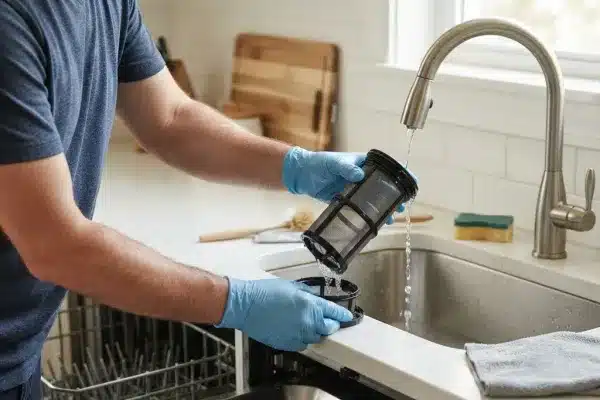 Monthly filter cleaning is the single most effective habit for dishwasher longevity.
Frequently Asked Questions
Where exactly is the filter on a Frigidaire dishwasher?
It is always at the bottom of the tub, under the lower spray arm. Remove the bottom rack, and you’ll see a round or oval assembly. Some models place it in a corner, others in the center.
Do all Frigidaire dishwashers have a removable filter?
Yes — Frigidaire has used self-cleaning filters in the past, but for many years now, all their dishwasher models have a user-removable filter that needs manual cleaning. If yours is very old (pre-2010), check the manual.
Can I run the dishwasher without the filter?
Never. Without the filter, food particles recirculate onto your dishes, clog the pump, and can damage the drain impeller. The filter must always be in place and locked.
How often should I replace the filter?
The filter itself is designed to last the life of the appliance. You only need to clean it. If the mesh is torn, broken, or warped, replace it with an OEM part from Frigidaire.
Why does my dishwasher still smell after cleaning the filter?
The odor might be coming from the drain hose or the rubber gasket. Run a vinegar cycle as described above. If the smell persists, check the drain hose for kinks or blockages — a similar issue can arise from a clogged vent under the sink.
Conclusion
Cleaning the filter on your Frigidaire dishwasher is a simple 15-minute task that solves most cleaning problems, eliminates odors, and extends the life of your machine. By following this step-by-step guide — locate, twist, scrub, and lock — you can restore peak performance without calling a repair technician. Make filter cleaning a regular part of your monthly kitchen routine, and you will enjoy spotless dishes and a fresher-smelling kitchen for years to come.
Your next step: Set a recurring monthly reminder on your phone. The next time you pull out the bottom rack, you’ll know exactly what to do.
