
A clogged filter is the most common reason range hoods lose suction, get louder, and fail to clear cooking odors. If your kitchen still smells like last night's stir-fry or your hood sounds like it's struggling, the fix takes less than five minutes: remove the filter, clean it, and slide it back in. Most models require zero tools.
This guide covers everything from identifying your filter type on different hood styles to deep-cleaning techniques, proper reinstallation, and knowing when to replace instead of wash. You'll also learn what to do when a filter refuses to budge and how often to perform this simple maintenance based on your actual cooking habits.
Why Filter Maintenance Matters More Than You Think
The filter traps airborne grease, smoke particles, and cooking vapors before they recirculate through your kitchen or exit through the vent. When it becomes saturated, several problems develop simultaneously:
- Airflow drops by as much as 50% in heavy-use kitchens, forcing the motor to work harder
- The fan becomes noticeably louder as it struggles to pull air through a blocked mesh
- Grease bypasses the filter entirely and coats the fan blades, motor, and ductwork
- Accumulated grease on the filter itself becomes a fire hazard—the National Fire Protection Association consistently lists range hood grease as a contributing factor in kitchen fires
A clean filter means your hood operates at peak efficiency, your kitchen stays fresher, and you reduce the risk of grease-related fires. For ductless hoods, the charcoal filter also removes odors and must be replaced regularly to maintain performance.
Tools and Materials You'll Need
Gather these items before you start to avoid stopping mid-task with greasy hands.
Required items
| Item | Why you need it |
|---|---|
| Liquid dish soap | Cuts through grease without damaging the aluminum mesh |
| Soft-bristle brush or non-scratch sponge | Removes stubborn residue without bending the mesh |
| Clean towel or drying rack | Filters must be bone-dry before reinstalling |
| Safety gloves | Protects hands from sharp edges and hot grease |
Nice-to-have items
- Kitchen degreaser – useful for filters that haven't been cleaned in months. A commercial spray degreaser works, or you can make a paste from baking soda and white vinegar.
- Step stool – essential if your hood is mounted high above the cooktop
- Bucket or large sink – for soaking heavily soiled filters
- Flashlight – helpful for spotting hidden clips or release mechanisms
- Screwdriver – some older models or specific brands use small screws instead of clips
Safety First: Two Precautions Before You Start
Taking a moment to prepare prevents common accidents.
Turn off power to the range hood. Unplug it if accessible, or switch off the circuit breaker. This eliminates any risk of electric shock while you're reaching near the motor and wiring.
Let the hood cool completely. If you've been cooking, the metal housing and filter can be hot enough to burn your fingers. Hot grease on the filter can also drip onto your hands or the counter.
Also clear the stovetop and counter below the hood. Remove pots, utensils, and anything that could be knocked over or catch drips.
Locating Your Range Hood Filter
Filters sit on the underside of the hood, but the access method varies by model and brand.
Wall-Mounted and Under-Cabinet Hoods
These are the most common types. The filter is typically held in place by two metal clips or a central pull-handle on the bottom panel.
- Clip-style filters: Look for spring-loaded clips on the left and right sides. Press them inward or upward to release.
- Handle-style filters: A small handle hangs down from the center. Pull it gently downward and the filter tilts out.
- Screw-mounted filters: Some older models use one or two screws on the underside. Turn counter-clockwise with a screwdriver.
Island Hoods
Island hoods often hide the filter behind a decorative cover on the underside. You may need to press a spring-loaded release button or unscrew a small access panel. Some models have a magnetic cover that simply pulls off.
Ductless Range Hoods
Ductless hoods use two filter types: a washable mesh filter for grease and a separate charcoal filter for odors. The charcoal filter sits behind an additional panel, often inside the hood near the fan motor. If you're unsure which type you have, understanding how a ductless range hood works can help you identify the components.
If you can't find the release mechanism, check your owner's manual. Most manufacturers also post PDF manuals online through their support pages.
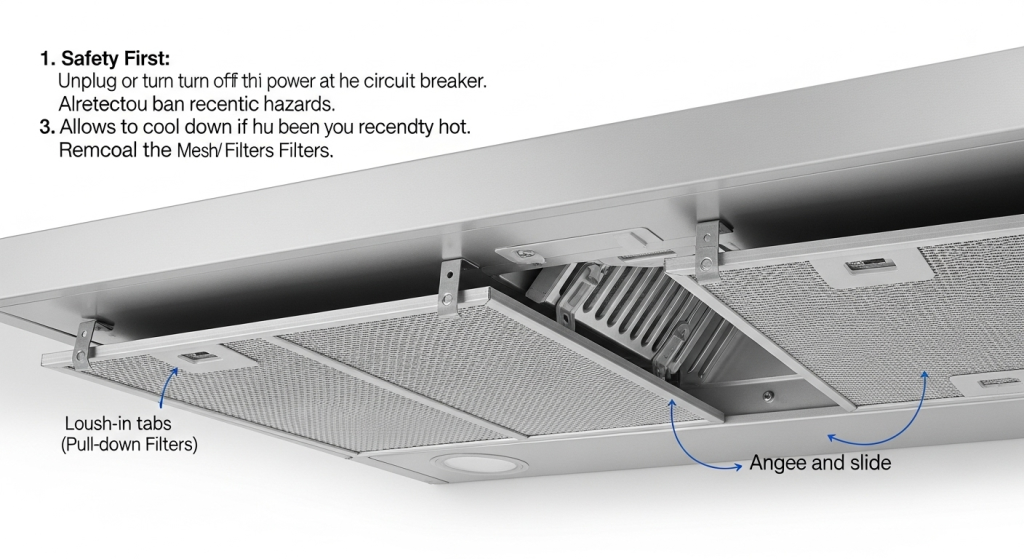
Two spring-loaded clips secure this under-cabinet hood filter. Press them inward to release the filter.
Step-by-Step: Removing the Filter Safely
Once you've located the filter, removal takes less than a minute when done correctly.
Release the clips or loosen the screws. For clip-style filters, push each clip inward until they disengage completely. For screw-mounted filters, turn counter-clockwise until the screws are free. Do not partially release one side and force the filter—both sides must be disengaged.
Tilt the filter downward at a slight angle. This prevents grease and debris from dripping back into the hood's motor compartment. Even a small amount of grease on the motor can reduce performance and create odors.
Slide the filter out toward you. Most filters travel on rails or a simple track. If the filter sticks, wiggle it gently from side to side while pulling. Never yank—you can bend the frame or damage the mounting rails.
Set the filter on a towel or in the sink immediately. Have a rag underneath to catch any dripping grease. Do not set a greasy filter directly on your countertop or stove.
Common mistake to avoid: Forcing the filter when it's still hot or when a clip hasn't fully released. A stubborn filter almost always means a clip is still partially engaged. Double-check each clip before applying more force.
Cleaning the Filter: Mesh vs. Charcoal
The cleaning method depends entirely on which type of filter your hood uses. Using the wrong method can destroy the filter.
Mesh or Aluminum Filters (Washable)
These are the standard metal mesh filters found in most ducted range hoods. They are designed to be cleaned repeatedly.
Hand wash method – This is the safest and most effective approach for heavily soiled filters.
- Fill your sink or a bucket with hot water and a generous squirt of liquid dish soap. Hot water helps dissolve grease more effectively than warm.
- Submerge the filter completely and let it soak for 10–15 minutes. For filters that haven't been cleaned in months, soak for 30 minutes and add a tablespoon of baking soda to the water.
- Scrub both sides with a soft-bristle brush, paying extra attention to the mesh intersections where grease accumulates most. A toothbrush works well for corners.
- Rinse thoroughly with hot water. If the water runs clear from all areas, the filter is clean. If you see cloudy water, repeat the soak.
- Shake off excess water and place the filter on a towel to dry completely. This usually takes 1–2 hours. Never reinstall a wet filter—moisture can promote mold growth inside the hood.
Dishwasher method – Some aluminum filters are dishwasher-safe, but you must check your manual first. If allowed:
- Place the filter upright in the top rack, angled so water drains freely
- Run a heavy-duty cycle with hot water and high heat drying
- Remove immediately and dry by hand to prevent water spots
Important: Never put charcoal filters in the dishwasher. Never use bleach or ammonia on aluminum mesh—these chemicals corrode the metal.
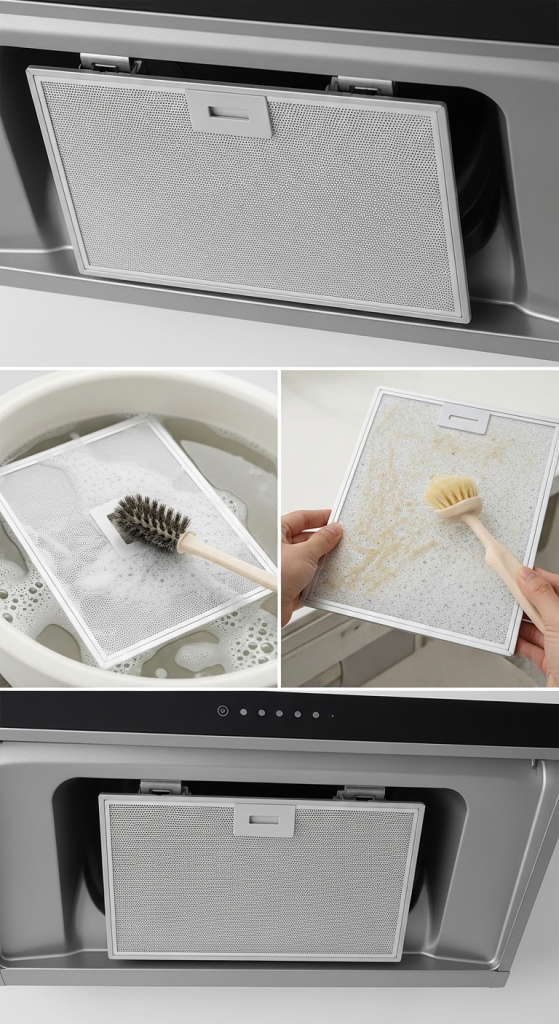
A 15-minute soak in hot, soapy water loosens built-up grease, making scrubbing much easier.
Charcoal Filters (Replaceable Only)
Charcoal filters cannot be washed. The carbon granules become saturated with odors and lose their effectiveness over time. Washing only redistributes the grease without restoring the carbon's absorbent properties.
- Replace charcoal filters every 3–6 months depending on cooking frequency. Heavy fryers should replace every 3 months; light cooks can stretch to 6 months.
- To remove a charcoal filter, open the access panel inside the hood (usually behind the mesh filter). Look for a small tab, clip, or screw holding the charcoal filter in place. Unclip and discard.
- Install the new filter by aligning it with the mounting points and securing the tab or screw. Some charcoal filters slide into a frame and lock with a quarter-turn.
Reinstalling the Filter Properly
Before reinstalling, ensure your mesh filter is completely dry. Any moisture will drip onto your cooktop or promote bacterial growth inside the hood.
- Orient the filter correctly. Most filters have a front/back marking, an arrow indicating airflow direction, or a handle that should face outward. Inserting it backward reduces performance.
- Slide the filter into the slot or along the rails, keeping it tilted at a slight upward angle.
- Push upward until the clips snap into place. You should hear a distinct click from each side.
- If your hood uses screws, tighten them gently. Overtightening can strip the threads in the plastic or metal housing.
- Test that the filter is secure by giving it a light tug. It should not rattle, shift, or hang loosely.
For ductless hoods, reinstall the mesh filter first, then close the access panel that holds the charcoal filter.
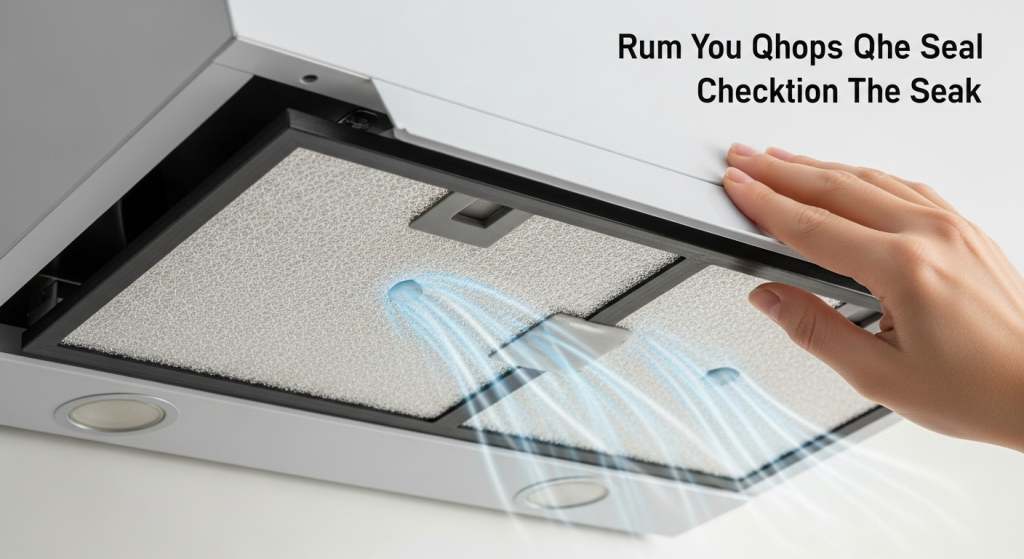
Align the filter with the tracks and press upward until both clips lock into place.
How Often to Clean or Replace Your Filter
Use this guide based on your cooking frequency. Mark your calendar or set a phone reminder so you don't forget.
| Cooking habit | Mesh filter cleaning | Charcoal filter replacement |
|---|---|---|
| Fry or sear several times a week | Every 3–4 weeks | Every 3 months |
| Moderate cooking (3–4 dinners per week) | Every 1–2 months | Every 4–6 months |
| Light cooking (weekends only) | Every 3 months | Every 6–12 months |
A simple rule of thumb: If you can see visible grease buildup on the mesh, it's time to clean. If the filter feels noticeably heavier than when it was clean, it's saturated. If your hood sounds louder than usual or odors linger after cooking, clean the mesh immediately and check the charcoal filter.
Troubleshooting Common Problems
Filter Won't Release
This is the most common frustration. Try these steps in order:
- Grease has glued it in place. Spray a degreaser around the edges where the filter meets the hood frame. Wait 5 minutes for the degreaser to penetrate, then rock the filter gently side-to-side.
- A clip is hidden. Shine a flashlight along the underside. Some hoods have a secondary clip near the center or behind a small cover panel.
- The filter is bent. Pull evenly from both sides. If the frame is warped, the filter won't seat properly after cleaning and should be replaced.
Persistent Odors After Cleaning
If cooking smells remain after cleaning the mesh filter, one of two things is happening:
- The charcoal filter (if you have a ductless hood) is exhausted and needs replacement. This is the most common cause of lingering odors.
- The ductwork is clogged with grease buildup. Ducted hoods can accumulate grease inside the exhaust pipe over years of use. If cleaning the filter doesn't help and the hood still moves little air, inspecting the duct is your next step. Proper installation of the duct system prevents these blockages from forming.
Hood Still Noisy After Cleaning
Noise usually comes from the fan motor, not the filter. But a loose filter can vibrate and create rattling sounds. Ensure the filter is seated firmly and all clips are engaged. If noise persists, inspect the fan blades through the opening—grease buildup on the blades can unbalance them. Wipe blades clean with a degreaser-soaked cloth.
Frequently Asked Questions
How do I know if my filter is washable or disposable?
Look at the material. Metal mesh filters are washable—they feel like aluminum screening in a metal frame. If the filter looks like a plastic frame filled with black granules or a bonded fabric pad, it's a disposable charcoal filter. Replace it; do not wash it.
Can I use bleach or ammonia to clean the filter?
No. Harsh chemicals corrode aluminum, weakening the mesh and creating sharp edges. Stick with dish soap, white vinegar, or a dedicated kitchen degreaser. For stubborn grease, a paste made from baking soda and water works exceptionally well.
Is it safe to run the hood without the filter installed?
Never. Without the filter, grease lands directly on the fan blades, motor, and interior surfaces. This creates a fire hazard, reduces performance, and voids most manufacturer warranties. If you're cleaning the mesh, wait until it's completely dry before reinstalling.
My range hood is above a wall oven—does this change anything?
The removal process is identical. Just be extra cautious of heat rising from the oven below. Never clean the filter while the oven is on or hot. Also ensure nothing is sitting on the oven surface that could be knocked over while you work above it.
What should I do if my filter is rusted or corroded?
Replace it immediately. A rusted aluminum filter has weakened mesh that can break apart or fail to trap grease effectively. Replacement filters are inexpensive and available from the hood manufacturer or universal options on major retail sites. Write down your hood's model number before shopping.
Conclusion
Removing and cleaning your range hood filter is a five-minute maintenance task that delivers noticeable results: fresher kitchen air, quieter fan operation, and a safer cooking environment. Set a recurring reminder on your phone based on your cooking frequency, and make degreasing the mesh part of your regular kitchen routine.
A clean filter also makes the rest of your hood easier to maintain. For tips on cleaning the hood's exterior and removing stubborn grease from stainless steel surfaces, browse our kitchen care guides. If you're planning a kitchen upgrade and need to install a new hood, understanding how to install a range hood under a cabinet will help you get it right the first time.
Next time you cook bacon or stir-fry, you'll notice the difference immediately: less smoke, less lingering smell, and a hood that works as hard as you do. For more appliance upkeep advice and recipes to test your newly efficient kitchen, visit our blog.
