
You've been staring at that empty diagonal space in your kitchen cabinet for years. It's the one spot where nothing ever seems to fit right. Pots vanish into darkness.
Spices pile up unreadable. A corner cabinet organizer pros and cons breakdown will show you whether buying one actually solves the problem or just adds another plastic disc that wobbles every time you open the door.
The average diagonal base cabinet measures between 24 and 36 inches wide at the front, leaving roughly 40 percent of that footprint as unusable dead space when left unmodified. Our research into kitchen storage solutions and NKBA guidelines points to rotating carousel systems as the most practical fix, provided you pick the right style for your specific cabinet shape. Let's walk through what's actually out there before you spend a dime.
Why Your Corner Cabinet Is Waste Space (And How to Fix It)
That diagonal cabinet has always been a joke in kitchen design. You reach in, poke around, and somehow the thing you want is buried three items deep at the back. The front row stays untouched while the rest of the shelf gathers dust and expired packets.
Most homeowners accept this as just how corner cabinets work. They aren't wrong, but they're also missing the simple fix that's been around for decades. Rotating organizers have turned those blind corners into fully accessible storage for over 40 years.
The real issue isn't the cabinet itself. It's the shape. Square and rectangular shelves are straightforward.
Diagonal corners fight you every step of the way because the deepest point sits right against the wall where nothing reaches. A carousel rotates everything forward so the back becomes the front with a simple turn of your wrist.
Read more about optimizing small kitchen layouts
Corner Cabinet Organizers: What Actually Exists
The market stacks a surprising number of options into a category most people think of as just "Lazy Susan." Understanding the differences matters before you measure anything.
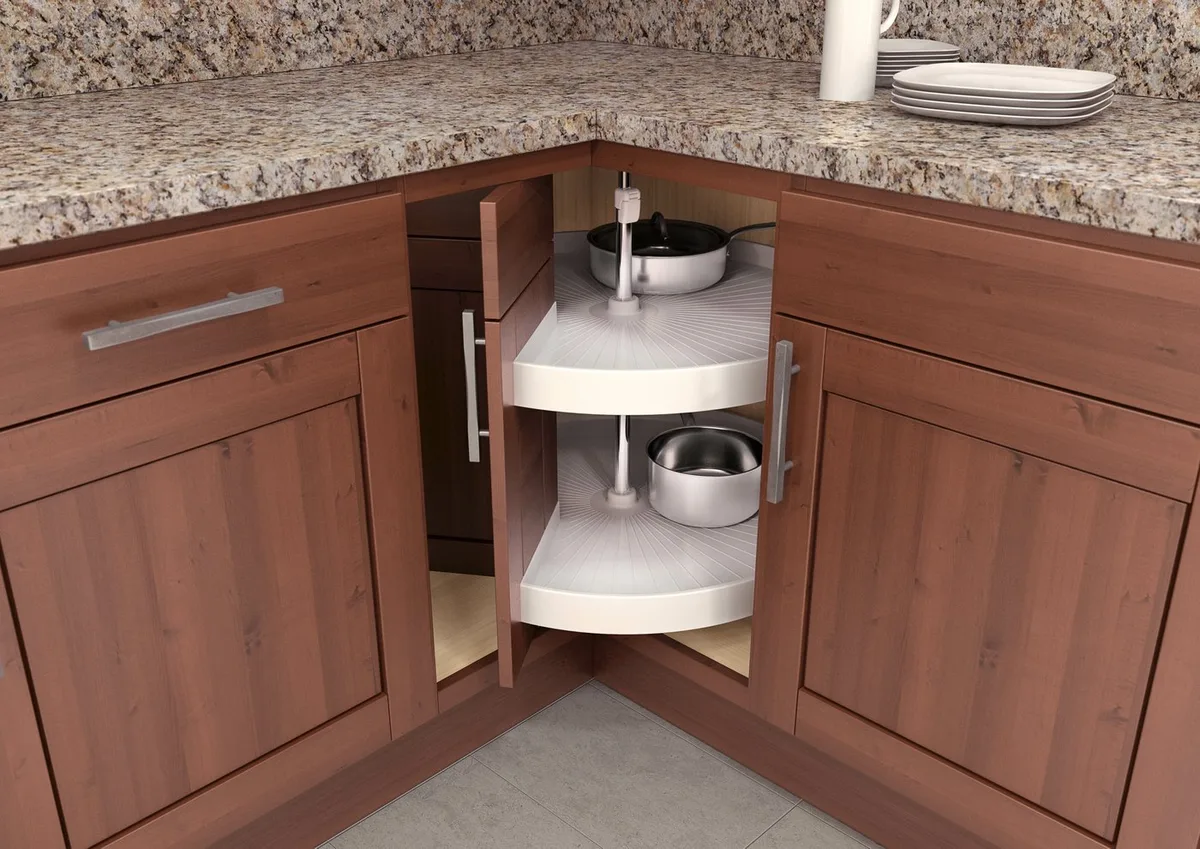
Rotating Carousels
Round trays that spin on a central post. These come in single-tier and dual-tier versions. Single-tier units sit flat on your shelf.
Dual-tier stacks two wheels vertically with a connecting rod. Standard diameters run from 12 inches up to 24 inches. Weight capacity typically sits between 25 and 50 pounds per shelf depending on bearing quality.
Tiered Step-Shelf Inserts
Non-rotating platforms that tier upward like steps. Each level rises so items on back rows stay visible without spinning anything. These work best in shallow upper cabinets where rotation might hit the ceiling.
Pull-Out Carousel Systems
Full-extension carousels mounted on runners that glide out like a drawer. The entire rotating platform pulls toward you before you even open the door. Premium versions use ball-bearing slides rated for 75 pounds or more.
Expect to pay two to three times the cost of a basic carousel.
Fixed Corner Racks
Wire or plastic grids that simply sit in the corner. No rotation. No movement.
These are the budget option and the ones most people regret buying because they don't solve the blind-corner problem at all.
Aggregate reviews consistently flag fixed racks as the biggest disappointment in this category. If you're looking for actual accessibility gains, skip straight to a rotating or pull-out design.
The Real Trade-Offs: Pros and Cons You'll Actually Live With
Every organizer type comes with real drawbacks that buyers rarely mention until after unboxing. Understanding these trade-offs upfront saves you from buyer's remorse.
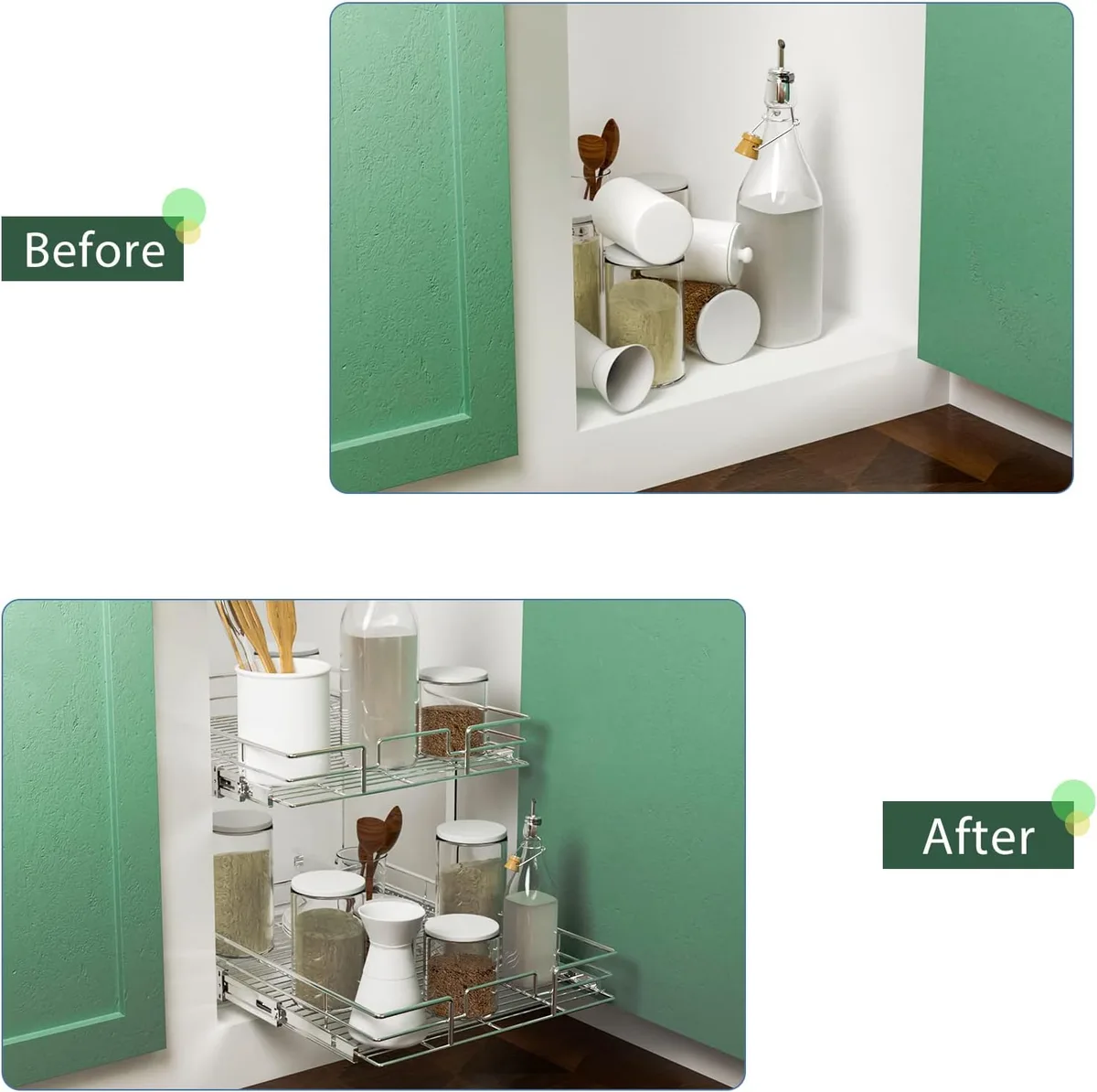
What Works Brilliantly
- Dead space becomes immediately usable storage without any cabinetry changes
- Everything spins into view so you stop digging through stacks of pots
- Glassware stays contained and protected instead of clinking against hard cabinet walls
- Installation takes 15 to 30 minutes with just a screwdriver and tape measure
- Units cost between $20 and $120, far cheaper than a cabinet redo
- Renters can take them along when moving since nothing modifies the cabinet itself
What Falls Apart Fast
- Cheap plastic bearings seize within a year, especially near sink humidity
- Oversized carousels block door closure unless you measure clearance first
- Double-carousel setups in wide blind corners often collide with each other mid-spin
- Heavy cast iron skillets on the top tier cause wobbling and misalignment
- Narrow diameter units leave a useless ring of dead space around the edges
- Wire metal organizers rust quickly in high-humidity kitchens near dishwashers
A U.S. Environmental Protection Agency guide on indoor humidity notes that relative humidity above 60 percent accelerates metal corrosion and warps wooden components faster than expected. If your kitchen runs warm and damp, stick with bamboo or coated plastic frames.
Which Type Fits Your Cabinet (And Which One to Skip)
Not every organizer works in every cabinet. The wrong type creates more problems than it solves, so match the unit to your actual space before ordering.
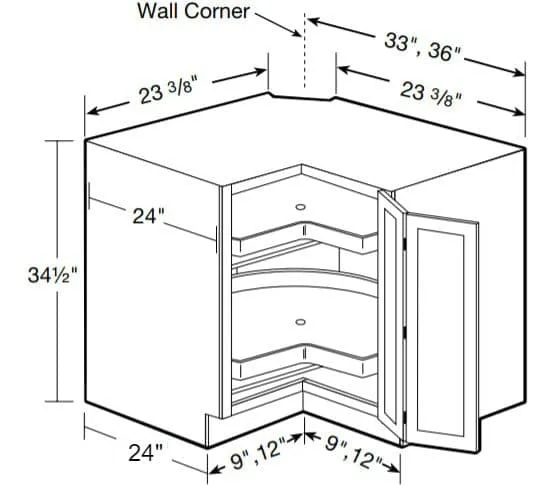
Base Corner Cabinets
These sit on the floor and hold heavy cookware. Look for single-tier units with a minimum 16-inch diameter and ball-bearing bases. Avoid dual-tier here because the top shelf sits too high to reach comfortably for most people.
Weight capacity should hit at least 40 pounds.
Upper Wall Corner Cabinets
Lighter items only. Dual-tier carousels shine here since overhead reach makes everything harder to grab. A 14-inch single tier works fine too if the cabinet is narrow.
Keep total loaded weight under 20 pounds to prevent door strain on the hinges.
Diagonal-Door Cabinets
These swing open wider but require careful clearance measurement. Measure from the hinge side to the farthest point the door reaches when fully open. Any carousel that extends past that line will jam against the door every time.
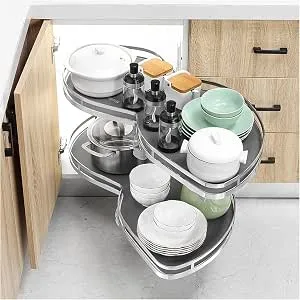
Blind-Corner Cabinets With Two Adjacent Doors
These need either a single corner carousel or a pull-out system. Two separate round carousels placed side by side almost always bump into each other during rotation. One unified unit eliminates the collision problem entirely.
Skip fixed wire racks for base cabinets and pull-out systems for shallow upper cabinets under 12 inches deep. The first won't rotate anything. The second simply won't fit.
Comparing the Main Options Side by Side
Running the main types against each other side by side makes the right pick obvious fast.
| Feature | Fixed Carousel | Pull-Out Carousel | Tiered Step Shelf |
|---|---|---|---|
| Rotation access | Yes | Yes with extension | No, visual only |
| Installation time | 15 minutes | 30 to 45 minutes | 10 minutes |
| Average cost | $20 to $60 | $100 to $250 | $25 to $50 |
| Weight capacity | 25 to 40 lbs | 50 to 75 lbs | 15 to 30 lbs |
| Best cabinet type | Base and wall | Wide blind corners | Narrow upper cabinets |
| Door clearance risk | Medium | High | Low |
| Wobble over time | Moderate | Low with quality slides | None |
Fixed carousels win on price and simplicity. Pull-out systems win on accessibility for heavy loads. Tiered shelves win only in awkwardly narrow spaces where rotation physically cannot work.
Most homeowners in standard 30-inch base corner cabinets should reach for a 16-inch single-tier carousel with ball bearings. It hits the sweet spot between capacity, price, and ease of install. Pull-out systems make sense only when the corner is truly blind and items weigh more than 30 pounds regularly.
When a Corner Organizer Is Worth It (And When It's Not)
This isn't a universal upgrade. Some kitchens gain enormous value from one. Others waste money on a solution that doesn't fit the actual problem.
Definitely Worth It When
- Your kitchen is under 150 square feet and every inch counts toward daily function
- You cook at home five or more nights a week and store pots, pans, and spices heavily
- You rent and need a non-permanent storage fix you can take with you
- The corner cabinet currently holds nothing but a broom or cleaning spray
- You recently reorganized the rest of the kitchen and need the final piece to tie it together
Skip It When
- The cabinet doors already struggle to close and adding an organizer guarantees a jam
- Your corner cabinet is narrower than 18 inches at the front opening
- You plan to replace the cabinets within the next two years anyway
- The organizer would sit directly above a dishwasher and face constant heat and vibration
- You prefer a minimalist look and don't mind occasional shelf digging
The same logic applies across different kitchen styles. A Miele dishwasher noise guide covers how appliance vibration affects nearby storage over time, which matters if your corner unit mounts adjacent to a running dishwasher.
FAQs About Corner Cabinet Organizers
Will my cabinet door actually close with a carousel inside?
Yes, if you measure properly before buying. Most standard base cabinets open wide enough for a 16-inch carousel, but narrow or deeply inset cabinets can jam. Measure the diagonal clearance from hinge to opposite corner and leave at least half an inch of breathing room on all sides.
What diameter size do I really need?
Match the carousel to your cabinet's smallest internal width, not the front opening. A 24-inch wide base cabinet usually fits a 16-inch round tray comfortably. Going larger creates wobble.
Going smaller leaves too much dead space around the edges to justify the purchase.
How much weight can these organizers actually hold?
Budget plastic models handle up to 25 pounds before the bearings feel strained. Mid-range metal or bamboo units with ball bearings typically support 40 to 50 pounds per shelf. Always check the manufacturer's stated limit rather than guessing, especially for heavy cast iron cookware.
Can I build my own instead of buying one?
Absolutely, and it often costs less while fitting your exact cabinet dimensions. A circular plywood base, a central PVC or wooden post, and a lazy Susan turntable bearing from a hardware store are all you need. This approach also lets you size it perfectly instead of hunting for a standard diameter.
Do these work in both base and upper corner cabinets?
They do, but the ideal design changes between the two. Base cabinets need sturdy single-tier units rated for heavier pots and pans. Upper cabinets benefit from dual-tier models since lighter items like glasses and spice jars fit better on two levels, and overhead reach makes stability more important.
How long does installation typically take?
Most basic carousel units install in 15 to 30 minutes with just a screwdriver and tape measure. Pull-out systems with slides take longer, usually 30 to 45 minutes, because you need to attach the runners precisely. If you're building a DIY version, add another 20 minutes for cutting and sanding the base.
Can I use a corner organizer under a sink with plumbing?
You can, but you'll likely need a split or U-shaped design that wraps around the P-trap. Standard round carousels won't work because the pipes block rotation. Measure the clearance around the plumbing first, then look for organizers specifically designed for under-sink corners.
Are bamboo organizers better than metal wire ones?
Bamboo resists warping and looks warmer in open cabinets, but it scratches easier and costs more. Metal wire handles heavy loads better and drains moisture quickly, making it ideal near sinks. Choose bamboo for dry storage and light items.
Pick metal if you're storing heavy pots or placing the unit in a damp environment.
Mistakes to Avoid When Buying Corner Storage
Even the best organizer fails when people skip the basics. These common errors show up repeatedly in buyer complaints and return reasons.
Measure the cabinet's interior diagonal, not just the front width. A 24-inch front opening might only give you 20 inches of actual space once you account for the back wall and side panels. Buying a carousel that's too large guarantees it will jam against the door frame.
Check the bearing quality before spending money. Cheap plastic bushings sound fine in the store, but they grind to a halt within months once kitchen grease and humidity get inside. Look for sealed ball bearings or stainless steel tracks.
Those last five to ten years without service.
Don't ignore the door swing radius. Some corner cabinets have doors that swing wide and hit adjacent counters or islands. Measure the full arc of your cabinet door before assuming a large carousel will fit.
Skip the fixed wire racks for primary storage. They look cheap and don't actually solve the accessibility problem. You still dig through the same blind corner, just with a flimsy grid in front of it.
Match the organizer to what you actually store. Heavy Dutch ovens need a low, single-tier unit with a wide base. Light spice jars and glasses work better on a dual-tier carousel that keeps everything visible at eye level.
Costs, Specs, and What You Actually Pay
Understanding pricing helps you avoid overpaying for features you don't need or buying something that breaks after three months.
| Type | Price Range | Best For | Expected Lifespan |
|---|---|---|---|
| Basic plastic carousel | $15 to $35 | Light spices, small cups, rentals | 1 to 3 years |
| Mid-range bamboo or coated metal | $40 to $90 | Everyday kitchen storage, pots and pans | 5 to 8 years |
| Heavy-duty ball-bearing unit | $80 to $150 | Daily use, heavy cookware, families | 8 to 15 years |
| Pull-out carousel system | $120 to $250 | Deep blind corners, limited reach | 10+ years |
| Custom DIY plywood build | $10 to $30 in materials | Exact fit, unique cabinet shapes | Varies with materials |
Price rarely tells the whole story. A $25 unit with flimsy bearings costs more over time than a $90 model that spins smoothly for a decade.
Weight capacity matters more than diameter. A 16-inch carousel rated for 25 pounds will sag and wobble with cast iron. A 14-inch unit rated for 50 pounds handles the same load without stress on the mechanism.
Assembly difficulty varies widely. Pre-assembled units take minutes. Flat-pack models require 20 to 30 minutes of patience and the right screws.
Custom builds depend entirely on your comfort with basic tools.
Installation hardware is usually included, but check what's in the box. Some models include only adhesive pads that fail in humid kitchens. Others provide screws and anchors that need a drill.
Having a basic toolkit ready saves frustration.
Final Recommendations Based on Your Situation
Picking the right organizer comes down to three questions: what are you storing, how heavy is it, and how often do you use it?
If you're storing lightweight spices and occasional glassware in an upper cabinet, a mid-range dual-tier bamboo carousel hits the sweet spot. It spins smoothly, looks clean, and costs under $70.
If your base cabinet holds heavy pots, pans, and small appliances, invest in a single-tier unit with sealed ball bearings and a weight rating of at least 40 pounds. That extra durability pays for itself when cheap units bind after a few months.
If your corner is deeply blind and you struggle to reach items at the back, a pull-out carousel system is worth the higher price. The glide mechanism puts everything within arm's reach before you even turn the tray.
For tight budgets or unusual cabinet shapes, a DIY plywood build with a standard turntable bearing solves the problem without buying into a size that doesn't exist. Hardware store bearings cost under $15 and spin just as well as expensive pre-made options.
Avoid fixed wire racks, undersized units, and anything with exposed plastic bearings near a sink. Those three choices create more problems than they solve and end up costing you time and money in the long run.
Measure once. Buy once. Your future self will thank you every time you open that cabinet and find exactly what you need on the first reach.
