
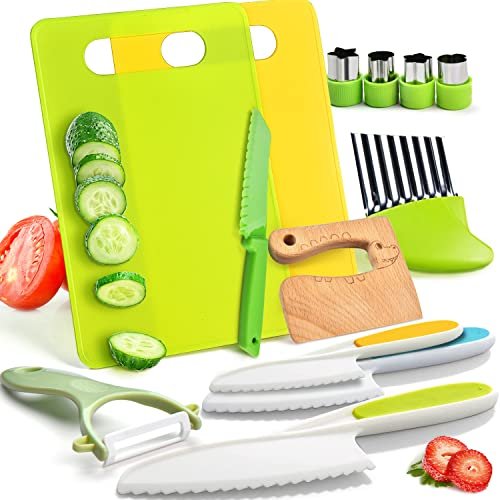
Introducing your toddler to the kitchen can feel daunting — sharp knives, hot surfaces, and heavy tools are real hazards. But the right Montessori kitchen tools turn that anxiety into a safe, rewarding experience. These child-sized cooking sets let kids chop, peel, and prepare real food with tools designed for their hands. The result? Improved fine motor skills, genuine independence, and a budding confidence that carries far beyond the kitchen counter.
Unlike toy kitchen sets meant for pretend play, real Montessori cooking tools are functional. Children learn actual knife techniques, practice measuring, and develop an early understanding of food and nutrition. Below, we break down what to look for, how to introduce these tools safely, and which sets offer the best value for your family.
What Makes a Montessori Kitchen Tool Montessori?
Montessori kitchen tools are not merely scaled-down versions of adult utensils. They share three defining characteristics:
- Real functionality — The tool actually works. A child-safe knife cuts a banana or a cucumber, not just play dough.
- Child-centered design — Handles are ergonomic for small grips. Weight is low. Balance is deliberate.
- Safety without removing the learning — Blades are serrated nylon or wood rather than steel, so they cut soft foods but cannot slice skin.
The philosophy stems from Dr. Maria Montessori’s observation that children learn best through purposeful, hands-on activity. Pouring their own water, slicing their own apple, and cleaning up afterwards builds self-reliance. Many parents see a noticeable shift in mealtime behaviour once children feel ownership of the preparation process.
Benefits of Real Cooking for Toddlers
A 2026 review of early childhood development research continues to point toward practical life skills as a cornerstone of executive function. When toddlers engage in real cooking, they:
- Develop fine motor control — Gripping a crinkle cutter or guiding a serrated knife through a carrot strengthens the small hand muscles needed for writing.
- Practice sequencing and patience — Following a multi-step recipe teaches order: wash, peel, cut, combine.
- Build vocabulary — Words like “serrated,” “peel,” and “dice” enter their spoken language naturally.
- Reduce picky eating — Children who help prepare food are more likely to taste it, even if it’s a vegetable they usually reject.
- Gain confidence — Completing a task that yields a real result (a bowl of fruit salad they cut themselves) is deeply satisfying for a young child.
For parents who want to bring these routines into their daily housework, the family kitchen becomes a richer learning environment than any plastic play set could offer.
What to Look for in a Kids Cooking Set
Not all safe knife sets are built equally. When evaluating options, consider these factors:
Material and Blade Type
| Material | Pros | Cons | Best For |
|---|---|---|---|
| Nylon/Plastic serrated | Cuts soft fruits/veggies, won’t cut skin, dishwasher safe | Won’t slice raw carrots or potatoes | Ages 2–5 |
| Wooden | Natural feel, more rigid edge, biodegradable | Requires hand drying, can splinter if not maintained | Ages 4–8 |
| Stainless steel with safety guard | Most like real knife, guard limits depth of cut | Heavier, slightly higher cost | Ages 6–12 |
Ergonomic Fit
A knife handle should be roughly the length of your child’s palm — around 8–10 cm for ages 2–4. If the handle is too long, the child cannot control the tip. If too short, their fingers creep up toward the blade.
Included Accessories
The best sets include more than just knives. A cutting board with a non-slip base prevents sliding. A crinkle cutter adds fun while teaching the sawing motion. Peelers designed for toddlers (with a rounded safety blade on the inside) allow children to peel cucumbers and apples without risk.
Storage and Organization
Look for sets that come with a storage box or roll-up pouch. Loose pieces get lost or dangerous when mixed with regular kitchen drawers.
How to Introduce Kitchen Tools to Your Toddler
Setting expectations early prevents accidents. Follow these steps before the first cooking session:
- Establish rules together — “Knives are for the cutting board, not for the table or the floor.” Demonstrate. Let them repeat the rule back.
- Model the grip — Show the “claw” grip (curled fingers on the holding hand) with your own hand before they try.
- Start with soft foods — A peeled banana, a slice of cooked sweet potato, a hulled strawberry. Success builds confidence.
- Supervise actively — If you must turn away, put the knife on the cutting board, not in their hand. A 2025 study published by the American Academy of Pediatrics reaffirms that adult supervision is the single most effective injury prevention for children under 6 using kitchen tools.
- Praise the effort, not the result — Crooked slices are fine. The learning is in the motion.
For more guidance on keeping a clean and orderly workspace while cooking with kids, our guide on what to use to wipe down kitchen counters offers practical tips using child-safe cleaners.
Top Montessori Kitchen Tool Sets for 2026
The sets below are widely recommended by Montessori practitioners and parenting communities. Each has been evaluated for safety, durability, and educational value.
13-Piece Starter Set with Nylon Knives
Toddler Kitchen Tools Set, 13 Pieces
 A compact 13-piece set featuring a crinkle cutter, serrated nylon knife, and child-size cutting board
This entry-level set includes a straight-edged nylon knife, a crinkle cutter, a peeler, and a cutting board. The plastic construction is lightweight — roughly the weight of a small apple — making it easy for even a two-year-old to lift. Parents report that the nylon knife handles bananas, cucumbers, and cheese well but struggles with firmer produce like apples. A good first set to test whether your child engages with food preparation before investing in a larger kit.
Best for: Ages 2–4, families new to Montessori cooking.
28-Piece Comprehensive Set with Crinkle Cutters
Suhctuptx 28PCS Toddler Knife Set
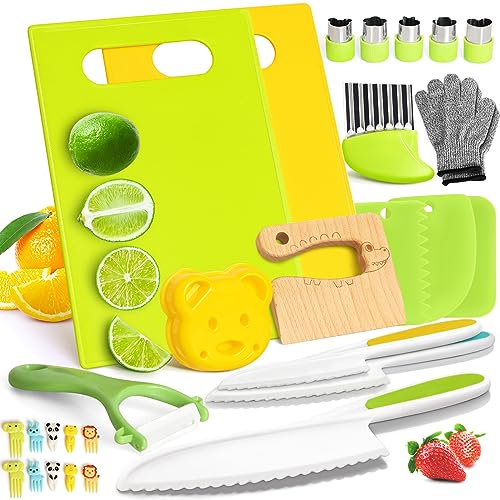 A crocodile-themed 28-piece set with multiple cutting tools and a sturdy cutting board
With 28 pieces, this set covers almost every beginner task: slicing, corrugated cutting, peeling, and spreading. The crinkle cutters are particularly popular — children love the zigzag pattern they produce on carrots and zucchini. The lightweight construction (0.49 pounds for the entire set) means even the youngest users can carry the storage container to the table. One caveat: the knives are small, so an older eight-year-old may outgrow the handle length.
Best for: Ages 2–7, families wanting variety without a high price point.
40-Piece Set with Recipe Book
Raymeer 40Pcs Kids Knife Set for Real Cooking
 A 40-piece set that includes a recipe book, cutting board, and multiple child-safe knives
This set stands out because it includes a recipe book written for children. The recipes are simple (fruit salad, veggie wraps, overnight oats) and use only the tools in the box. The 40 pieces include measuring cups, a small whisk, and a wooden rolling pin — encouraging baking as well as cutting. Parents note that the recipe book motivates children to complete the full sequence from preparation to eating. The storage box is compact enough to fit on a standard kitchen shelf.
Best for: Ages 3–10, families who want structured activities alongside free exploration.
18-Piece Wooden and Plastic Hybrid Set
Acessorz 18 Pieces Montessori Kitchen Tools Cookware Baking Toy
 A combination set with wooden safe knives and plastic serrated tools for varied food preparation
This set blends wooden knives (which have a slightly firmer edge) with plastic serrated tools. The wooden knives are effective on bread and soft cheese, while the plastic serrated blade handles fruits and vegetables. The set also includes a Y-shaped peeler that fits small hands — a tool many adult peelers fail to accommodate. The wooden pieces require hand drying, so factor that into clean-up time.
Best for: Ages 3–6, families interested in natural materials with backup plastic durability.
30-Piece Baking and Cooking Combo
ASSBABY and GWAWA 30 Pcs Kids Montessori Cooking Kitchen Toys
 A 30-piece set that includes both cooking knives and baking accessories like a rolling pin and cookie cutters
If your child enjoys baking as much as chopping, this set bridges both worlds. It includes a small rolling pin, cookie cutters, a silicone spatula, and a whisk alongside the safe knives. The baking tools are genuine silicone and wood — not thin plastic that breaks after one use. The knives are identical in safety design to other sets, but the variety encourages longer engagement. Some parents find the 30-piece count overwhelming for daily use, so consider storing the baking accessories separately.
Best for: Ages 3–10, children who show interest in both savoury and sweet preparation.
14-Piece Focused Starter Set
Salufo 14PC Montessori Toy Safe Kitchen Knife Set
 A bright yellow 14-piece set with a cutting board designed for easy grip and stability
This set keeps things simple: a serrated knife, a straight knife, a peeler, a crinkle cutter, and a cutting board with non-slip corners. The bright yellow colour makes every piece easy to spot on the counter — and on the floor, after enthusiastic toddlers drop them. Parents appreciate that the set doesn’t include extraneous pieces that never get used. The cutting board has a slight lip that prevents food from sliding off, a detail missing from many competitors.
Best for: Ages 3–6, minimalists who want quality over quantity.
Chanking 13-Piece Bright Colour Set
Chanking 13 Pieces Kids Safe Knife Set for Real Cooking
 A rainbow-coloured 13-piece set with child-safe plastic knives and a compact storage container
The colour-coded design of this set makes it easy for non-reading children to identify tools: “Use the green knife for the cucumber, the blue one for the bread.” The plastic is sturdy but not brittle — it bends slightly under pressure rather than snapping. The set’s main limitation is that the plastic blades struggle with firmer foods like raw apple or carrot. Stick to soft produce and cooked vegetables.
Best for: Ages 2–5, families who value visual organisation.
Leking 8-Piece Wooden and Serrated Combo
Leking 8 Pcs Wooden Kitchen Knife Set for Kids
 A compact 8-piece set featuring wooden-handled knives, a potato slicer, and a sandwich cutter
This eight-piece set is the most compact on this list, which is an advantage for small kitchens or families who cook on the go (camping, grandparents’ houses). The potato slicer and sandwich cutter add a fun element that feels like a craft project. Wooden tools require more maintenance than plastic — they should be dried immediately after washing — but they also feel more substantial in a child’s hand, which some children prefer.
Best for: Ages 3–7, families who want a portable, minimal set.
Safety Checklist for Every Session
Before your child picks up any tool, run through this quick check:
- Cutting board is stable (moisten a paper towel underneath if no non-slip feet exist).
- Child is seated at a table at waist height (standing at a counter is acceptable if the counter is at elbow height).
- Long sleeves are rolled up, hair tied back.
- Only one sharp tool is out at a time.
- A “knife down” rule is agreed upon before starting — the tool goes flat on the board whenever the child stops cutting.
A common mistake parents make is handing over all the tools at once. Start with the crinkle cutter alone for the first few sessions, then add the straight knife once that skill is solid.
Frequently Asked Questions
What age is suitable for Montessori kitchen tools?
Most branded sets recommend ages 2–12. In practice, a two-year-old can use a crinkle cutter with supervision, while a four-year-old can manage a serrated nylon knife on soft food. By age seven or eight, many children are ready for guarded stainless steel knives. Always match the tool to your child’s coordination, not just their age.
Are Montessori kitchen knives safe for toddlers?
Yes, when used correctly. Nylon, plastic, and wooden knives sold in Montessori sets cannot cut skin under normal use. The serrated edge is designed to saw through produce fibres but not through flesh. The primary risk is not cutting — it’s dropping a heavy tool or using it near a sibling. Supervision remains essential. The CDC’s injury prevention guidelines for home kitchens reinforce that no child under six should be left unattended with any cutting tool, regardless of how “safe” it is marketed.
What items come in a Montessori kitchen tool set?
A typical set includes 1–2 serrated nylon or wooden knives, a crinkle cutter, a peeler, a cutting board, and sometimes a sandwich cutter or small whisk. Larger sets add measuring cups, a rolling pin, cookie cutters, and a recipe book. Avoid sets with many identical pieces — variety matters more than quantity.
How do Montessori kitchen tools benefit child development?
They strengthen fine motor skills (pincer grip, bilateral coordination), practise executive function (sequencing, impulse control), and build practical life competence. Children who cook regularly also show higher willingness to try new foods, according to observations from early childhood nutrition programmes.
Can Montessori kitchen tools be used for real cooking?
Absolutely. That is their purpose. A child can chop vegetables for a salad, peel a cucumber for a snack, or spread peanut butter on bread. These are real meals — not play. The difference from adult tools is the safety design and ergonomic fit.
What features to look for in kids’ kitchen tools?
Prioritise: non-slip cutting board, comfortable handle length (match to child’s hand span), dishwasher-safe (if plastic), and a recognised safety certification mark. Avoid sets with painted surfaces that may chip, and avoid any knife advertised as “unbreakable” — that usually means it’s too rigid and may splinter.
Cleaning and Maintenance
Proper care extends the life of these tools and keeps them hygienic.
- Nylon and plastic tools: Most are top-rack dishwasher safe. To be safe, hand-wash in warm soapy water and air dry.
- Wooden tools: Hand-wash only, dry immediately. Every few weeks, rub with food-grade mineral oil to prevent drying and cracking.
- Cutting boards: Wash with hot soapy water after each use. If deep grooves appear, sand the board lightly with fine-grit sandpaper and re-oil.
For related advice on keeping your kitchen equipment in top condition, see our guide on how to clean inside of stainless steel dishwasher — especially useful if your child’s tools go through a full cycle.
When to Upgrade to Sharper Tools
Around age seven or eight, many children become frustrated with nylon knives that cannot slice a raw apple or a carrot. This is the right time to introduce a guarded stainless steel knife. Look for:
- A finger guard that sits 1–2 cm from the tip
- A handle that fills the child’s palm (not just fingers)
- A blade no longer than 12 cm
Introduce the new tool exactly as you did the first one: model, supervise, start with soft foods, and gradually increase difficulty.
Conclusion
Investing in the best Montessori kitchen tools for toddlers transforms cooking from a chore into an opportunity. These safe kids cooking sets give children the autonomy to prepare real food, develop essential motor skills, and build confidence that spills into every area of life. Start simple — a crinkle cutter and a banana — and let your child’s curiosity guide the pace.
The kitchen is one of the richest classrooms a child will ever enter. Equipped with the right tools and a patient adult nearby, even a three-year-old can learn that making food is both a skill and a joy. For more tips on creating a child-friendly kitchen environment, explore our blog for practical strategies on everything from cleaning routines to kitchen safety.
