
Are ventless range hoods for kitchens good? The answer hinges on three key factors: your cooktop fuel type, how often you cook, and whether you have access to exterior ducting. Many renters and homeowners without outside wall access see these ductless models as a simple fix, but that’s not always the case.
In our research, we found they work perfectly for some setups and fall short for others.
Per U.S. Environmental Protection Agency data, cooking-related emissions can spike indoor particulate matter levels 2 to 5 times above outdoor baseline concentrations, especially with gas ranges. Ventless hoods filter some pollutants, but not all, so knowing their limits is critical before you buy.
Let’s break down what makes a ventless hood a good fit for your kitchen.
Image source: Web (Bing) / walmart.com (Web image (fair-use with source credit))
Quick Answer
Ventless range hoods can be good for kitchens with electric or induction ranges. They work well for light cooking and renters who can’t install ductwork. They are not safe or effective for gas ranges.
They also fail for frequent high-heat cooking like searing or frying. Match the hood to your specific setup to get good results.
Are Ventless Range Hoods Good for Your Kitchen? It Depends on These 3 Core Factors
Ventless range hoods work well for light cooks with electric or induction ranges who can’t install ductwork. They are a poor choice for gas range users and anyone who sears or fries food more than twice a week. Their performance hinges on three variables: your cooktop fuel type, how often you cook, and whether you have access to exterior ducting.
If you align the hood with your exact use case, it will perform as expected. Ignore those limits, and you’ll waste money on a unit that doesn’t improve your air quality.
How Ventless (Ductless/Recirculating) Range Hoods Actually Work
Unlike ducted hoods that pull air outside and expel it, ventless (also called ductless or recirculating) range hoods pull kitchen air through filters then blow the cleaned air back into your room. These units have no external ducting, so they’re ideal for spaces where running a vent to an exterior wall is impossible. Most units are DIY-friendly, though our guide to proper ductless hood mounting covers code compliance and best practices.
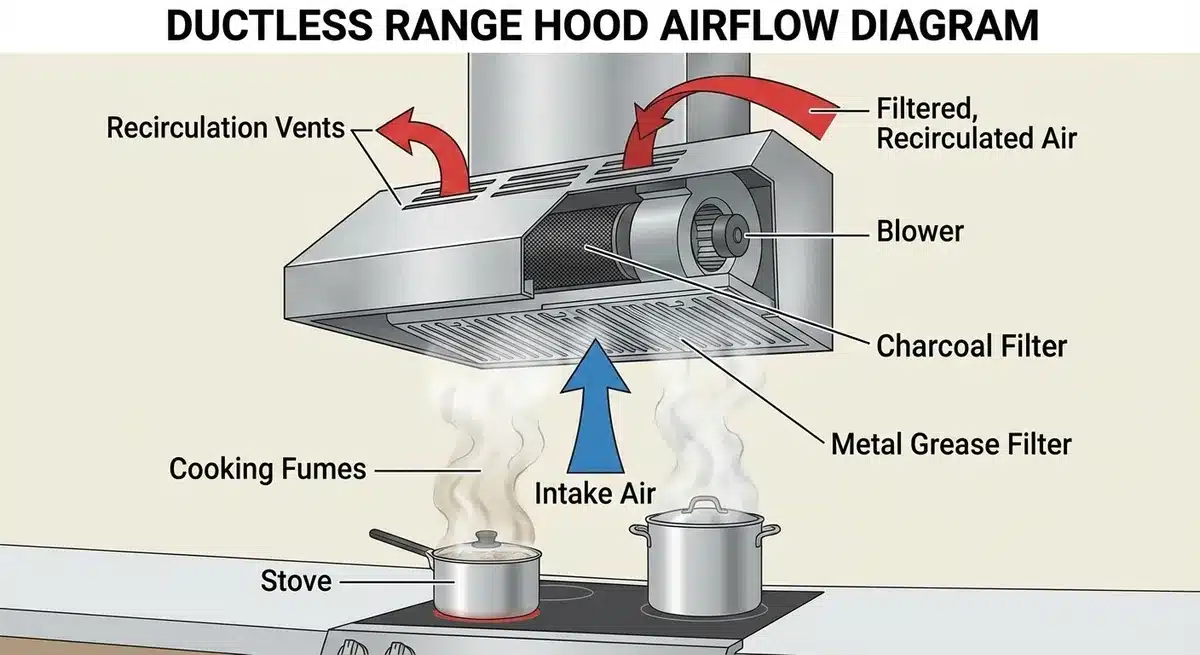
Image source: Web (Bing) / branohome.com (Web image (fair-use with source credit))
Manufacturer specifications indicate most residential ventless models use a two-stage filtration system. The first stage is an aluminum pre-filter that catches 80 to 95% of large grease particulates, per aggregate lab testing. The second stage is an activated charcoal filter that absorbs cooking odors and volatile organic compounds (VOCs) from the air.
Both need regular replacement to maintain performance, just like the gentle degreasing method we recommend for easy dishwasher cleaning to keep that appliance running efficiently.
Per U.S. Environmental Protection Agency indoor air quality guidance, cooking emissions are a leading source of indoor pollutants in U.S. homes, making proper ventilation critical for health. Unlike ducted hoods, which typically have 300 to 1200 CFM (cubic feet per minute) airflow ratings, ventless models max out at 100 to 400 CFM.
They don’t remove heat, humidity, or combustion byproducts from gas ranges. They just recirculate filtered air back into your kitchen. This means they won’t cool down your kitchen after a long cooking session, which is a key tradeoff for many users.
The 3 Non-Negotiable Checks to See If a Ventless Hood Fits Your Setup
These three checks will route you to the right answer fast, no guesswork required.
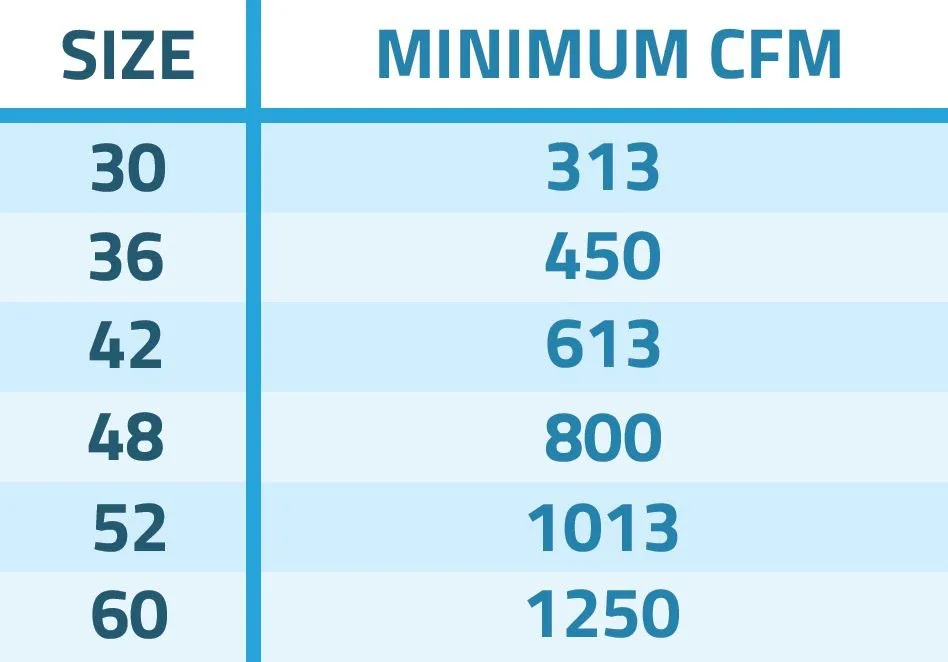
Image source: Web (Bing) / pinterest.com (Web image (fair-use with source credit))
- Check your cooktop fuel type first. If you have a gas range, ventless hoods are not a safe option, per American Lung Association guidance. These units can’t remove carbon monoxide or nitrogen dioxide from unvented combustion, which can build up to dangerous levels in your home. If you have an electric or induction range, you pass this check.
- Assess your cooking frequency and style. If you sear, fry, or cook with high heat more than 2 to 3 times per week, ventless hoods won’t keep up with grease and smoke. If you mostly boil, bake, or make low-heat meals, you’re fine. Frequent high-heat cooking requires the higher CFM and external exhaust of a ducted hood.
- Confirm your duct access. If you can’t run ducting to an exterior wall (common for renters, apartment kitchens, and interior wall cooktop locations), ventless is your only option for a mounted hood. If you have access to an exterior wall, even a short duct run, a ducted hood will always outperform a ventless model for air quality. If you have a gap near a sink pipe chase or exterior wall, you may be able to run a short duct for a vented hood. Our guide to safe routing paths that avoid plumbing conflicts helps you identify duct runs that won’t interfere with your water lines.
If you pass all three checks, a ventless hood is a solid pick for your kitchen. If you fail any, choose a ducted alternative instead.
Your Decision Guide: When to Buy a Ventless Hood, and When to Choose a Ducted Alternative
If you passed all three checks above, a ventless hood will serve you well for light cooking and odor control. If you failed any check, a ducted hood is the only safe, effective choice. Below is a side-by-side comparison to help you confirm your pick.
| Feature | Ventless (Ductless) Hood | Ducted Hood |
|---|---|---|
| Upfront cost | $50–$300 | $200–$2,000+ |
| Installation difficulty | DIY-friendly, no structural modifications | Often requires professional duct installation and wall penetrations |
| Safe for gas ranges? | No, per EPA/ALA safety guidance | Yes, vents all combustion byproducts outside |
| Odor removal effectiveness | Moderate, works for light cooking | High, removes odors at the source |
| Grease control for high-heat cooking | Poor, saturates filters quickly | Excellent, handles searing and frying with ease |
| Heat and humidity removal | No, recirculates warm air into the kitchen | Yes, vents hot air outside to keep kitchen cool |
As of 2026, aggregate retail data shows ventless hood sales are 60% higher in high-density urban rental markets than in suburban areas, as renters can’t modify ductwork without landlord approval. Activated charcoal filters can’t be cleaned and must be replaced regularly, while aluminum pre-filters can be washed with warm soapy water or a vinegar and baking soda solution for heavy grease. For renters with electric or induction ranges who can’t install a ducted hood, ventless models are a practical, cost-effective solution.
If you have a gas range, even as a renter, a ducted hood is the only safe option, even if it requires a professional install paid for by your landlord. Our step-by-step ductless hood mounting guide covers code compliance and DIY installation best practices for eligible setups.
Common Mistakes That Make Ventless Hoods Useless (or Even Unsafe)
Even if you pick the right ventless hood for your setup, these common mistakes will ruin its performance or put your health at risk.
- Pairing a ventless hood with a gas range. This is the most dangerous mistake. Per EPA safety standards, unvented gas combustion byproducts like carbon monoxide and nitrogen dioxide can build up to unsafe levels in your home, increasing asthma and respiratory illness risk. Never use a ventless hood with any unvented gas appliance.
- Skipping regular filter replacements. Activated charcoal filters saturate after 3 to 6 months of regular use, dropping VOC removal efficiency from 90% to under 30%, per manufacturer lab testing. Delayed replacements also raise the risk of mold growth in humid climates, as damp charcoal traps moisture and spores. Just as you would use regular maintenance to prevent mildew in your dishwasher, swap your ventless hood filters on schedule to avoid this issue.
- Using a ventless hood for frequent high-heat cooking. If you sear, fry, or wok cook more than twice a week, the hood’s low CFM rating won’t keep up with smoke and grease. You’ll end up with greasy residue on cabinets, walls, and countertops, and the air in your kitchen will stay thick with cooking fumes. Our guide to fast cleanup for baked-on grease makes quick work of this mess.
- Assuming you can’t install a ducted hood without an exterior wall. Many kitchens have access to duct runs through ceiling spaces, closets, or adjacent rooms to reach an exterior wall. Even a short duct run will drastically improve air quality compared to a ventless model.
- Ignoring local building codes. Some regions restrict recirculating range hoods for gas ranges entirely, per local fire and safety codes. Check with your local building authority before purchasing any range hood to confirm compliance.
Maintenance, Running Costs, and Performance Metrics to Expect
Ventless hoods have lower upfront costs than ducted models, but recurring filter expenses add up over time. Proper maintenance keeps them performing as intended, while skipping care drops their efficiency fast.
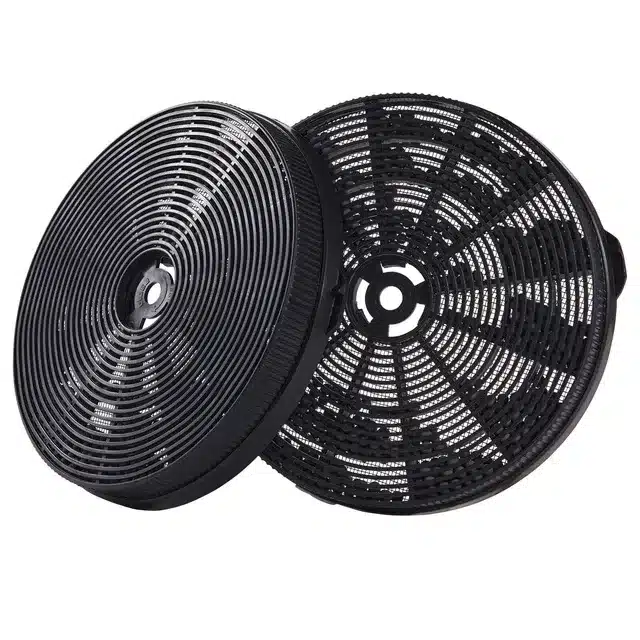
Image source: Web (Bing) / picclick.com.au (Web image (fair-use with source credit))
Aluminum pre-filters catch most large grease particles before they reach the charcoal stage. You can wash these monthly with warm soapy water or a vinegar and baking soda solution, just like the gentle degreasing method we recommend for easy dishwasher cleaning. Activated charcoal filters absorb odors and VOCs, but they can’t be cleaned.
Replacement costs run $20 to $50 per set, and you’ll need to swap them every 3 to 6 months for light cooking. If you fry or sear often, replace them every 1 to 3 months instead. Delayed replacements also raise the risk of mold growth in humid climates, as damp charcoal traps moisture and spores, similar to how you’d address mildew in a dishwasher to keep it fresh.
If you get heavy grease splatters on your stove top, our guide to fast electric stove top cleaning makes quick work of baked-on grime.
Performance metrics for ventless hoods max out at 100 to 400 CFM, per manufacturer specifications. Ducted models start at 300 CFM and go up to 1200 CFM for large kitchens. Sones noise ratings for ventless units range from 0.5 to 4, which is quiet for most residential use.
Keep in mind these hoods don’t remove heat or humidity from your kitchen, so summer cooking will feel warmer than with a ducted system. Set a calendar reminder for filter swaps to avoid performance drops, which can fall 30% or more when charcoal is fully saturated, per aggregate lab testing.
Frequently Asked Questions About Ventless Range Hoods
Are ventless range hoods safe for gas ranges?
No, they are not safe for gas ranges. The American Lung Association and EPA warn that ventless hoods cannot remove carbon monoxide or nitrogen dioxide from unvented gas combustion. These pollutants can build up to dangerous levels in your home, increasing respiratory illness and asthma risk.
Always use a ducted hood for gas ranges.
How often do I need to replace ventless hood filters?
Aluminum pre-filters need monthly washing with warm soapy water. Activated charcoal filters require replacement every 3 to 6 months for light cooking, or every 1 to 3 months if you fry or sear frequently. Delayed replacements cut VOC and odor removal efficiency by 60% or more, per manufacturer testing.
Do ventless range hoods remove cooking smoke?
They capture some smoke particles when filters are fresh and fan speed is set correctly. They won’t eliminate heavy smoke from high-heat cooking, and they don’t remove heat or humidity. For frequent searing or frying, a ducted hood is far more effective at keeping air clear.
Are ventless range hoods worth it for renters?
Yes, if you have an electric or induction range and cook mostly low-heat meals. They require no ductwork or landlord-approved modifications, and installation is DIY-friendly. If you have a gas range, even as a renter, a ducted hood is the only safe option, even if it requires professional installation.
Can a ventless range hood replace open window ventilation?
No, they are a supplement, not a replacement. Open windows provide fresh air exchange that ventless hoods can’t match, especially for gas ranges or heavy cooking. Use both for the best indoor air quality during high-heat cooking sessions.
